
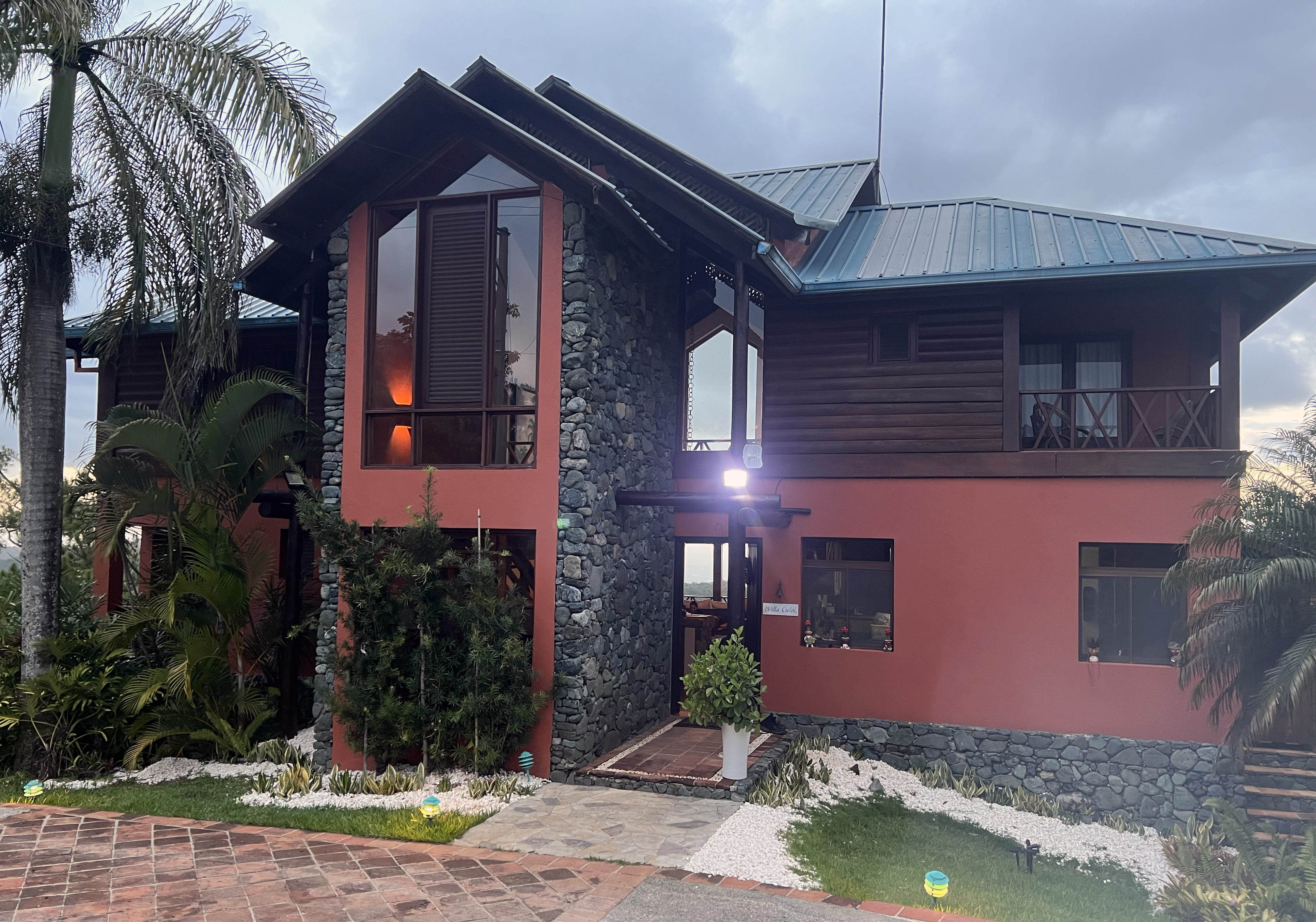
There is a particular failure common to luxury developments in tropical climates: the architecture ignores the place. Glass towers rise on beachfronts, sealed against the very environment people came to experience. Air conditioning replaces the breeze. Imported marble replaces local stone. The result is a building that could be anywhere — and belongs nowhere.
Alterra was designed around a different principle. The architecture here does not impose itself on the landscape. It listens to it.
Materials That Come from the Mountain
The primary building materials at Alterra are river stone and native wood — materials that exist within miles of the site. The stone is drawn from the riverbeds of the Yaque del Norte and the Jiménoa, where decades of water have smoothed and colored it in shades of grey, ochre, and rust. Set into the exterior walls, it gives each residence a weight and texture that connects it immediately to the terrain. These are not decorative accents. They are structural elements that tie the building to the geology beneath it.
The wood comes from local species: Caribbean pine, mahogany, and roble. It appears in the balcony railings, the ceiling beams, the louvered panels that regulate airflow between rooms. Over time, it weathers — not in a way that suggests neglect, but in a way that suggests the building is aging alongside the forest around it. This is intentional. Architecture that resists its environment eventually looks out of place. Architecture that accepts it becomes part of the landscape.
Open Sightlines and Natural Ventilation
Jarabacoa’s climate makes something possible that most tropical developments cannot achieve: natural ventilation as a primary design strategy. At 1,700 feet, the air is cooler, drier, and consistently moving. The Alterra residences are oriented to capture the prevailing mountain breezes, with floor plans that create cross-ventilation through open living areas, louvered walls, and covered terraces that extend the living space outward.
The sightlines are equally deliberate. Windows and terraces are positioned not for symmetry but for view: the valley below, the river corridor, the ridgeline of the Cordillera Central. From certain angles, the boundary between interior and exterior dissolves entirely — a sliding glass wall opens to a terrace that opens to the hillside, and the room becomes part of the mountain.
Balconies as Living Rooms
In most residential developments, the balcony is an afterthought — a narrow ledge appended to a bedroom. At Alterra, the balconies are designed as primary living spaces. They are deep enough for dining, wide enough for gathering, and shaded enough to be used throughout the day. In the highland climate, where the temperature rarely demands retreat indoors, these outdoor rooms are where daily life happens.
The railings are a mix of wood and metal cable — materials that provide safety without obstructing the view. The floors are poured concrete with a natural finish, cool underfoot and durable enough to weather the mountain rains. Overhead, the rooflines extend beyond the building envelope, creating covered zones that remain dry and usable even during the afternoon showers that sweep through the valley in the wet season.
Density Without Crowding
One of the most common mistakes in residential development is building too many units too close together. The economics are obvious: more units, more revenue. But the result is a community that feels like a parking lot — every window looking into someone else’s kitchen.
Alterra’s site plan takes the opposite approach. The residences are staggered across the hillside, oriented so that each one looks outward toward the valley rather than inward toward its neighbor. The spacing between buildings is generous — filled not with parking or hardscape, but with native vegetation that preserves the feeling of being on a mountainside rather than in a compound.
A Building That Belongs
The measure of good architecture in a place like Jarabacoa is not how impressive the building looks from the road. It is how natural it feels from inside. Does the breeze reach the bedroom? Does the terrace frame the mountain? Does the stone on the wall look like it came from the river below — because it did?
At Alterra, the answer to each of these is yes. The architecture does not shout. It does not compete with the landscape or try to improve upon it. It simply takes its cues from the mountain, the river, and the climate — and builds accordingly.
Back to Stories